





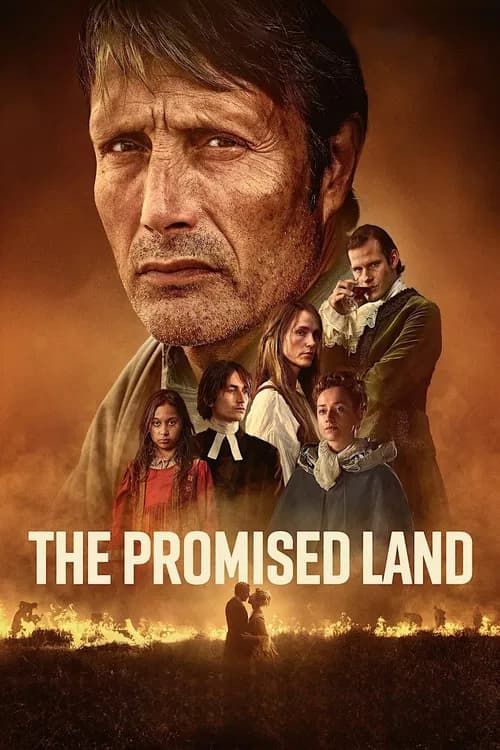
The Promised Land
HeartGuard score
How suitable a title is for Christian viewers, from 0 to 100. It weighs the content meters and the worldview.
- 80–100Recommended
- 60–79Watch with care
- 35–59Think it throughThis film
- 15–34Strong caution
- 0–14Not recommended
HeartGuard score
How suitable a title is for Christian viewers, from 0 to 100. It weighs the content meters and the worldview.
- 80–100Recommended
- 60–79Watch with care
- 35–59Think it throughThis film
- 15–34Strong caution
- 0–14Not recommended
Worldview score
What the story celebrates or condemns.
Why +1 for this film
The film condemns tyranny, cruelty and racism, and shows Ludvig's hunger for status costing him dearly until he chooses the outcast child over his title. Its violence and its unmarried relationships are not framed as ideals, though Ann Barbara's revenge killing is left morally open.
- +2Affirms faithPresents faith in God positively and as true
- +1Positive valuesThis filmHonesty, sacrifice and family win out
- 0Mixed or neutralNo clear stance
- −1AmbivalentShows sin without judging it either way
- −2Glamorises sinMakes sin look attractive and rewarding
Age guide
How suitable this film is for each age group.
Why 16+ for this film
Brutal violence, including a scalding death and torture, plus sexual coercion and assault, is shown as wrong but remains distressing. An implied sexual relationship also appears.
- Under 8No
- Ages 8–12No
- Ages 13–15Wait
- Ages 16–17Check first
- AdultsCheck first





A gripping, beautifully made historical drama about pride, power and belonging, in which a hardened soldier slowly learns to love an outcast child. It contains brutal, sometimes graphic violence, torture, sexual coercion and scattered strong language, so it is best kept for older teens and adults.
Watch guide
What's in it?
LanguageStrong but scattered
There are a few f-words, one c-word in a crude outburst, several uses of 'shit' and frequent milder swearing. The orphan girl swears too and is told to stop. Crude sexual remarks come mainly from the villain.
BlasphemyA few exclamations
There are a handful of 'goddamn' exclamations, including from a child, and a casual 'thank God'. Elsewhere God is spoken of sincerely by a priest.
Sex and nudityImplied scenes, crude talk
Ludvig and his widowed housekeeper begin a sexual relationship. A noblewoman offers herself to the villain to save Ludvig's life, and the scene is set up suggestively. The villain boasts of using female servants, and there is coarse talk about the body and sex.
RelationshipsCoercion, affair
A cruel landowner preys on servant girls and physically assaults his cousin to force a marriage. Ludvig has an unmarried relationship with Ann Barbara while also courting a noblewoman for advancement. The film condemns the coercion.
ViolenceBrutal, sometimes graphic
A runaway farmer is boiled to death as a public punishment, and a woman is beaten. Settlers are murdered, there is a revenge raid with killings, and Ludvig is tortured with scalding water. A woman kills her husband's murderer with a knife. The cruelty is shown as evil, but some moments are hard to watch.
Frightening scenesSustained menace
A child's illness, a hard winter, livestock found slaughtered, murders at night and the torture scenes would deeply upset children. The atmosphere stays tense and bleak.
Drugs and alcoholHeavy drinking
The villain is said to drink from morning to night, the king is described as a drunk, and schnapps toasts and wine appear. None of it is glamorised.
AttitudesRacism, cruelty challenged
A Romani girl is called slurs, treated as cursed and driven out by superstitious settlers. Officials are corrupt and lie, and a nobleman abuses his power. The film sides with the outcast, and Ludvig's pride and his abandoning of the girl are shown as failings he must repent of.
OccultSuperstition only
Settlers superstitiously fear the Romani girl as cursed and a bringer of the devil, but no magic or occult practice is shown as real. The film treats this belief as cruel prejudice.
- To knowContent to know about
- Skip for kidsSkip for younger viewers
- DiscussWorth discussing
- 0:23:04
Crude language
At dinner Schinkel launches into a crude, sexually coarse tirade and mocks Ludvig's illegitimate birth.
- 0:42:11
Graphic violenceSkip if under 16
Schinkel parades the runaway farmer Johannes before his guests and has him scalded to death as a so-called punishment.
- 1:07:08
Sexual content
Ludvig and the widowed Ann Barbara, both lonely, begin a sexual relationship.
- 1:19:15
AbuseSkip if under 16
Schinkel accuses Edel of sleeping with Ludvig and violently assaults her.
- 1:23:09
Violence
Livestock are found slaughtered and two settlers are murdered in the night.
- 1:28:07
Racism and abandonment
The settlers demand the Romani girl be sent away as bad luck, and Ludvig gives in, leaving her at a convent as she cries after him.
- 1:43:25
Torture and killingSkip if under 16
Ludvig is tortured with scalding water, Edel offers herself to Schinkel to save him, and a revenge killing with a knife follows.
- Late
Sad ending
The aftermath brings a death that is told rather than shown and leaves a lingering sense of loss and grief, with only a muted, bittersweet close.






How to play
- 1. Draw a cardOne person reads the question out loud.
- 2. Everyone answersThere are no wrong answers. Listen before you reply.
- 3. Pass it onThe next person draws, until the deck is done.



Faith & story
What does it say?
What's it about?The plot, without the ending

Denmark, 1755. Ludvig Kahlen, a captain of humble origins who worked his way up during a quarter of a century in the German army, petitions the royal treasury for leave to cultivate the barren Jutland heath, land that all insist cannot be farmed. If he succeeds, he wants a noble title. Funding the venture from his small pension, he takes on runaway servants Ann Barbara and her husband Johannes, and later the travelling folk who roam the moor, including a fierce, half-wild orphan girl. But the ruthless local landowner Frederik de Schinkel claims the moor as his own and will stop at nothing to drive Ludvig out. Meanwhile Schinkel's cousin Edel, pressed to marry him, sees in Ludvig a way of escape.
Through a faith lensHow it connects to the Bible

The film is at heart about the hunger for status, and it shows how close Ludvig comes to gaining a title while losing the people who make his life worth living. His willingness to send away a child to keep the settlers on side is the low point, and the film asks whether he can come to himself, like the son in Jesus' parable. Scripture repeatedly calls God's people to protect the foreigner and the fatherless, and the film sides firmly with the outcast Romani girl against the fear and contempt of her neighbours. Schinkel's treatment of his servants, whom he exploits, abuses and kills, echoes the warnings against those who oppress the poor and withhold their due. His claim that God and life are only disorder stands against the biblical picture of a God who brings order and peace. The film's hunger for revenge on Schinkel gives families room to talk about why vengeance belongs to God rather than to us. Ludvig's patient, back-breaking work on the heath also recalls the dignity of labour and the way the diligent are rewarded, though the film is clear that hard work alone cannot fill an empty heart.
Fruit of the SpiritWhich fruit does it show?

7 out of 9 fruits ripe in this film
Ripe grapes are shown in the film, buds are missing
- Peace
- Gentleness
Love grows slowly in Ludvig as he becomes a father to the orphan girl, and Ann Barbara's care for her during her illness is real Kindness. Joy breaks through when the child finds the first seedling. Patience and Self-control mark Ludvig's long winter labour on the heath, and Faithfulness shows in his refusal to betray the king's claim even under torture. The parish priest brings Goodness, sheltering runaways and standing up for the settlers. Against this, Schinkel embodies Hatred, Fits of anger and Jealousy, and his feud with Ludvig is a story of Rivalries and Strife. Divisions appear when the settlers turn on the Romani girl, Drunkenness runs through the manor and the court, and Sexual immorality shows in Schinkel's abuse of servants and in Ludvig's unmarried relationship.
The charactersExamples to follow or avoid






 Ludvig KahlenMads Mikkelsen
A proud, disciplined soldier of humble birth, driven to win a title. His stubbornness is both his strength and his flaw, and his story turns on whether he will choose people over position.
 Ann BarbaraAmanda Collin
A runaway servant whose husband is killed by Schinkel. Tough, honest and warm towards the orphan girl, she challenges Ludvig's coldness.
 Frederik de SchinkelSimon Bennebjerg
A vain, cruel landowner who abuses servants, assaults his cousin and orders murders. He is clearly the villain, and the film shows his power as rotten.
 Anmai MusMelina Hagberg
A Romani orphan sold by her parents and despised by others as cursed. Spirited and foul-mouthed at first, she becomes the heart of the household and the person who changes Ludvig.
 Anton EklundGustav Lindh
The parish priest, eager to see a church on the moor. He helps runaways find work and bravely confronts Schinkel's men when the settlers are threatened.
How Christians are portrayed
The parish priest is portrayed warmly: kind, a little comic, sincere in his faith and willing to risk himself to defend the weak. Religion also appears in its darker form, as the settlers' superstitious fear that the dark-skinned girl brings the devil and misfortune, which the film treats as cruel. A convent appears briefly as a place that takes in homeless children, without much comment either way.
Community
What other Christians think
What did you notice?
A sex scene, shown or clearly implied?
Is this appropriate for Christians to watch?
Thinking of children? Add the youngest age you'd show it to.
Review
Helpful reviewer
The star beside a name
Given to members whose reviews 25 or more people have marked Helpful.
It rewards reviews that help other families decide, not how many someone writes. It's a sign others have found their reviews thoughtful, not a verdict on anyone's faith.
Found a review useful? Mark it Helpful: it tells the writer, and helps others find the best reviews first.
Details
Film details
- In theatres
- Feb 2, 2024
- On streaming
- May 16, 2024
- Cast
- Mads Mikkelsen, Amanda Collin, Simon Bennebjerg, Kristine Kujath Thorp
- Director
- Nikolaj Arcel
- Studios
- Zentropa International Berlin, Zentropa International Sweden, Zentropa Entertainments
- Genre
- Action, Drama, History
- Run time
- 2h 7m
- Age rating
- US NR · UK 15
How we analysed this
We counted language, blasphemy and other content in the film's dialogue and read it with the plot and film details, then rated each content area against our rubric and worldview scale, using AI models calibrated on reference titles. Not yet reviewed by our team. Confidence: medium.
Score = 100 − 16 × content concern (3.48) + 8 × worldview (+1) = 52
This is a guide to help families choose with wisdom, not a verdict on anyone's conscience ().
Updated 2026-10-14